



Some countries are toured and others are lived in layers. South Africa is one of the latter: in a single week you can follow a leopard from an open vehicle at dawn, toast with a Chenin Blanc among mountains and watch a penguin colony on a white-sand beach.
That is why a custom trip to South Africa is designed differently. Private reserves, vineyards, cities and the coast each have their own seasons, distances and reservations. Those who arrive prepared combine everything without rushing. Those who don’t spend more time on roads than facing the landscape.
This guide goes beyond the postcard. Besides the regions, the lodging and the activities, I tell you what almost nobody explains: what paperwork you need as a U.S. traveler, what is rude, what is illegal, what you can and cannot bring, and where it is worth booking a table.


Some countries are toured and others are lived in layers. South Africa is one of the latter: in a single week you can follow a leopard from an open vehicle at dawn, toast with a Chenin Blanc among mountains and watch a penguin colony on a white-sand beach.
That is why a custom trip to South Africa is designed differently. Private reserves, vineyards, cities and the coast each have their own seasons, distances and reservations. Those who arrive prepared combine everything without rushing. Those who don’t spend more time on roads than facing the landscape.

This guide goes beyond the postcard. Besides the regions, the lodging and the activities, I tell you what almost nobody explains: what paperwork you need as a U.S. traveler, what is rude, what is illegal, what you can and cannot bring, and where it is worth booking a table.
Why South Africa Is Unlike Any Other Destination
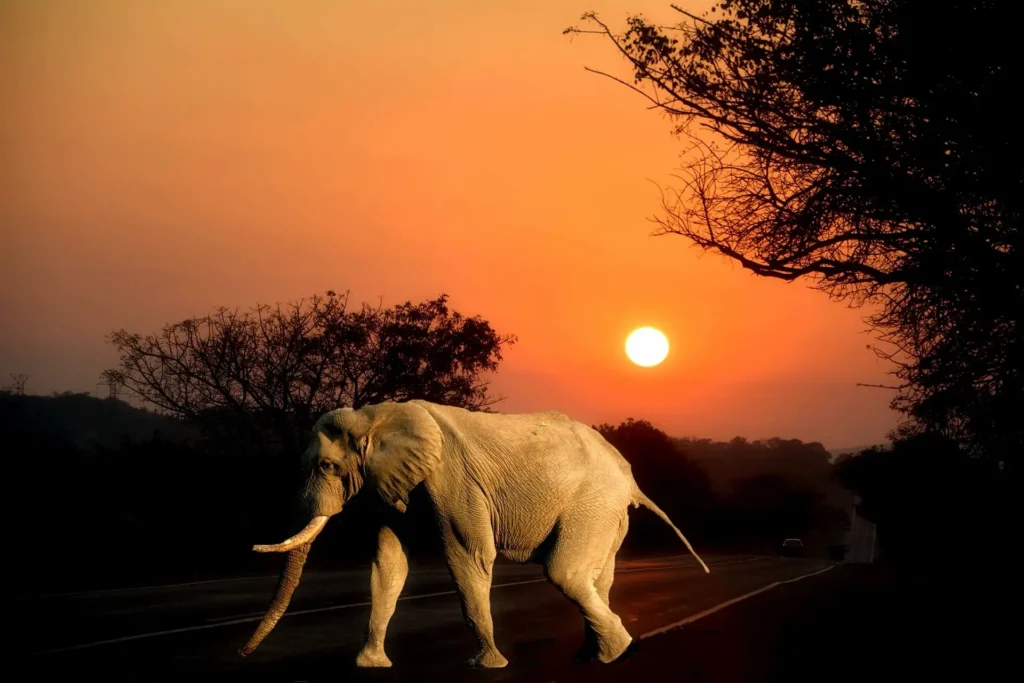
South Africa is one of the few places in the world where you can:
- Go on a first-class safari in the morning and toast with a glass of wine facing a vineyard in the afternoon.
- See the Big Five (lion, leopard, elephant, rhinoceros and buffalo) in the same region.
- Climb Table Mountain and, the same day, visit a beach with African penguins.
- Tour Nelson Mandela’s cell on Robben Island and, days later, dine at a world-class restaurant.
What makes it unique is the contrast. It has the infrastructure of a modern country, with good roads, domestic flights and a solid food scene, and at the same time the wildest nature on the continent. It also has a recent history that cannot be ignored: apartheid ended barely three decades ago and it is still present in museums, neighborhoods and conversations.
It is a destination you enjoy far more with good logistics. There are long distances, seasons that change the safari and rules worth knowing. That is why below you will find sections on etiquette, laws, customs and visa.
Be a traveler. Not a Tourist.
Ready to design your next adventure?
Best Time to Visit

South Africa’s seasons are those of the Southern Hemisphere, that is, the opposite of the U.S. The best time depends on what you want to experience, and my advice is not to choose the date before defining the priorities of the trip.
| Season | Months | The best | Keep in mind |
|---|---|---|---|
| Fall | March to May | Mild weather in Cape Town and the vineyards, with the harvest ending in March. May already opens the dry safari season. | Days get shorter toward May. Some weeks in April concentrate school vacations and local holidays. |
| Winter | June to August | The best safari season: vegetation is low and animals gather near water. The malaria risk in Kruger is very low. In Hermanus the whale season begins. | Safari mornings are cold, so bring a coat. In Cape Town it is the rainy and cold-sea season. |
| Spring | September to November | Wildflowers on the west coast around August and September, pleasant weather at the Cape, whales at their best and a safari still very good until October. | Rains return to the north toward November. |
| Summer | December to February | Long days, beaches and vineyards in their best weather at the Cape. | Heat and dense vegetation in Kruger, which makes sightings harder, and higher malaria risk. Christmas and New Year are very high season: book many months ahead. |
If safari is the priority, winter and early spring win. If you are looking for the city, the vineyards and the coast, summer and early fall are magnificent. Many of my clients combine both, and when that is the case I design the order of the trip according to the weather in each region.


Real Budget: How Much Does a Trip to South Africa Cost?
I’ll be straight with you: in South Africa almost the whole budget is decided by the safari. Cape Town, the vineyards and the Garden Route can be experienced at many levels of luxury, but a private reserve lodge is what weighs most. These figures are market estimates from November 2026, per person and in U.S. dollars.
Flights from the U.S.
There are nonstop flights from Atlanta to Johannesburg, and from other cities the usual route is a connection in Europe, the Middle East or Atlanta. The ticket typically costs about $1,200 to $2,200 per person in economy, depending on your departure city and the season. On top of that come domestic flights between cities and reserves, which are best included from the start.
Safari: Lodging per Night in a Private Reserve
| Level | Per person per night | What to expect |
|---|---|---|
| Entry | $400 to $600 | Comfortable lodges, with Big Five safaris and all meals. |
| Mid | $600 to $900 | Lodges with careful design and very solid guides. The wildlife you see is similar to that of higher levels. |
| Luxury | $900 to $1,500 | Signature cuisine, private pools, a spa and high-level design. |
| Ultra-luxury | $1,500 to $3,500 or more | The most exclusive brands, such as Singita, Londolozi and MalaMala. |
These rates are for Sabi Sands and usually include lodging, all meals, two safari outings a day (with night drives), basic drinks, park fees and transfer from the airstrip. Premium wines and spirits, the spa and helicopter flights are paid separately. From May to September, the dry season, prices rise 20% to 30%. Inside Kruger National Park, park accommodation costs between $50 and $200 per person per day, in a much simpler style and with less privacy at sightings.
Cape Town, Vineyards and the Garden Route
The rest of the trip costs a fraction of the safari. Boutique hotels, houses with sea views, wine estates and good restaurants are available at many levels of luxury, and meals in South Africa go much further than in Europe or the U.S. Wines, tastings and starred tables are what move the total most.
Estimated Total Budget (per person, 12 to 14 days, with 3 or 4 nights of safari)
| Level | Estimated total, with flights from the U.S. | What the trip looks like |
|---|---|---|
| Essential | $6,200 to $8,600 | Entry-level lodge on safari, mid-range hotels in the cities and the main activities. |
| Intermediate | $9,800 to $14,000 | Mid-level or luxury lodge, boutique hotels, tastings, guides and a memorable table. |
| Premium | From $17,400, and over $30,000 at the very top | Luxury or ultra-luxury lodges, villas, helicopter, private guides and fine-dining dinners. |
These ranges include flights, lodging, safari meals, transfers and the main activities. They include the design and full management of the trip: bookings, transfers, guides and support. They do not include tips, personal shopping or travel insurance. The nightly safari rates are market reference rates. The investment is protected by designing the trip well: I help you decide where it is worth spending and where not.
Where to Stay in South Africa
In South Africa, lodging is part of the experience. The usual approach is to combine different types: a safari lodge, a boutique hotel in the city and a wine estate.
Safari Lodges in Private Reserves
Lodges in private reserves, such as Sabi Sands, which borders Kruger National Park, offer open vehicles, trackers and small groups. They almost always include lodging, meals and activities. The schedule revolves around two outings a day, one at dawn and one at sunset, and dinner is usually served outdoors, by the fire.
Malaria-Free Reserves
Madikwe and Pilanesberg, in the North West province, and Eastern Cape reserves such as Addo, Shamwari and Amakhala are malaria-free. They are ideal for families, for traveling with small children and for those who prefer to avoid prophylaxis.
Boutique Hotels and Houses in Cape Town
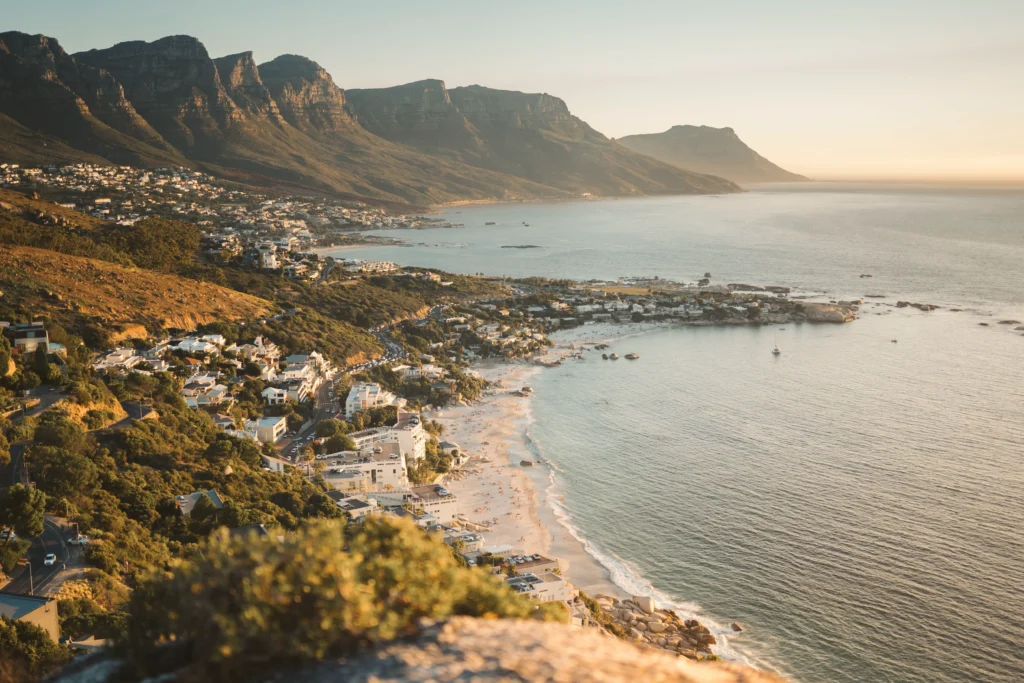
Camps Bay, the V&A Waterfront, Constantia and the center offer boutique hotels and villas with views of the sea or Table Mountain. Choosing the area well matters: it decides whether you walk to restaurants and the beach or depend on a car.

Wine Estates in the Winelands
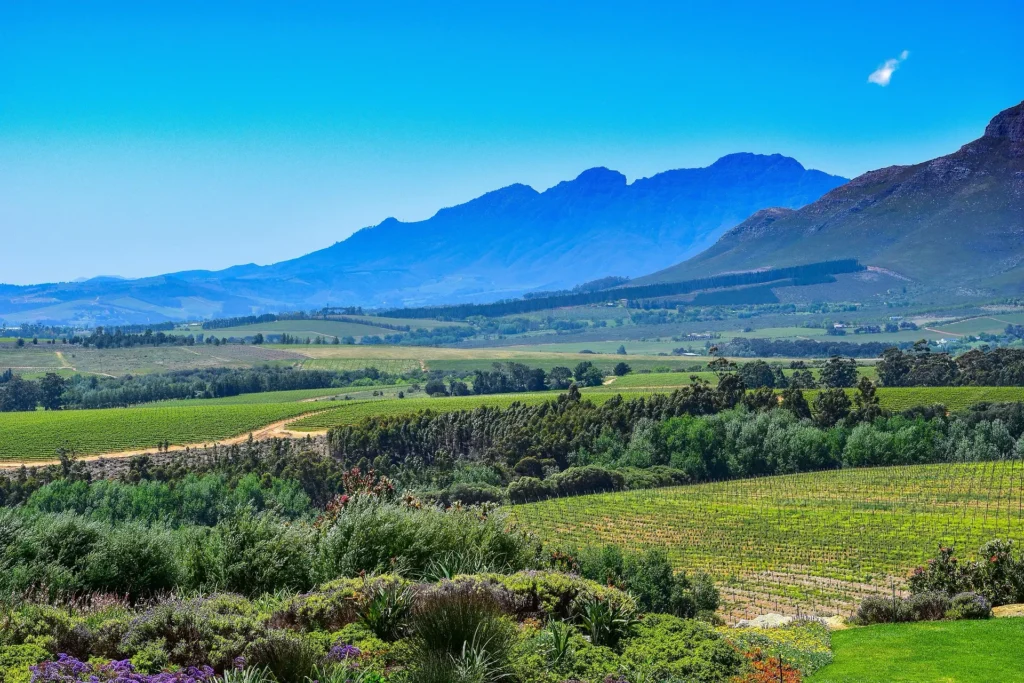
In Franschhoek and Stellenbosch you can sleep inside a vineyard, with tastings, an on-site restaurant and mountain views. They are a perfect pause between the city and the safari.
Garden Route
Between Knysna, Plettenberg Bay and Tsitsikamma there are hotels facing the sea, cliffside houses and small forest lodges. It works well as a quiet stretch of a long trip.
What to Expect on Your Trip Through South Africa
Language. South Africa has 11 official languages. English is spoken and understood throughout the country, especially in tourism, business and cities, so you will communicate without trouble. A few local words open smiles: sawubona (hello, in Zulu), dankie (thank you, in Afrikaans) and lekker (nice or delicious).
Currency and cash. The currency is the South African rand (ZAR). Visa, Mastercard and American Express cards are accepted at hotels, restaurants, stores and most lodges, and ATMs are plentiful in cities and malls. Even so, carry some cash in rand for tips, markets and rural areas. Withdraw money at ATMs inside malls or banks, not on the street.
Getting there. There are nonstop flights to Johannesburg from Atlanta; from other cities the usual route is a connection in Europe, the Middle East or the U.S., with total travel time of more than 20 hours. South Africa is 6 to 7 hours ahead of the U.S. East Coast, depending on the season.
Transportation. To move between regions, domestic flights are used. In cities there are Uber and Bolt, and for long trips a private driver is best. In South Africa people drive on the left. If you want to rent a car for the Cape and the Garden Route, it is a good option for experienced travelers, but avoid driving at night in remote areas.
Connectivity and adapters. Outlets are mainly type M, with three thick prongs, and type C is also found. Voltage is 230 V and frequency is 50 Hz. Bring a universal adapter that includes type M, and check that your devices support 230 V. An eSIM keeps you connected from the moment you land.

Weather and clothing. Travel in layers. On a winter safari, mornings are cold and midday is warm. Bring neutral colors (beige, olive green, khaki), a hat, sunscreen and comfortable shoes. In Cape Town, wind and weather changes within a single day are normal.
Health. The Cape, the Winelands and the Garden Route have no malaria. In Kruger and the northern reserves, the risk is higher from November to April and very low from May to September. Talk to your doctor or a travel clinic ahead of time about whether prophylaxis suits you. Get travel insurance with medical and evacuation coverage.
Safety. South Africa is a fascinating destination and, with precautions, safe for tourism. Large cities, such as Johannesburg, Cape Town and Durban, have high crime rates, so I recommend private transfers or trusted apps, not walking at night in unfamiliar areas, keeping valuables out of sight and visiting townships only with an authorized guide. During the safari, following your guide’s instructions to the letter is the most important thing. Check the current U.S. State Department advisory before you go.
Culture. South Africa is called the “rainbow nation” for its mix of peoples, languages and traditions. Warm, direct dealings are valued, and the concept of ubuntu, the idea that we are people through other people, appears again and again in conversations. Music, sports and recent history are part of everyday life.
Food. The braai, the charcoal barbecue, is almost a social ritual. Try biltong (dried meat), bobotie (a baked spiced meat dish), Cape Malay cuisine, Durban’s bunny chow and seafood from the coast. In wines, Chenin Blanc, Pinotage and classic-style sparklings (Cap Classique) are the hallmarks of the Winelands.
My basic guide for any trip
The Big Five: The Reality Behind the Magic
A safari is not guaranteed. It is worked at.
Animals don’t keep a schedule. A leopard can show up ten minutes after leaving the lodge or hide for three days. What does change the odds is choosing the reserve and the season well, staying enough nights (three or four at minimum) and having a guide and a tracker who read the tracks. That is why private reserves, with off-road and night drives, usually give better sightings than open parks.
Something similar happens in Cape Town. The Table Mountain cable car closes when there is strong wind, and wind is frequent. That is why I never leave that visit for the last day, and I check the forecast before leaving. The whales of Hermanus also have their season, which comes closer to September and October.
The key is realistic expectations, preparation, patience and a good guide.
Etiquette: Dos and Don'ts in South Africa
South Africans are warm, direct and hospitable. These customs help you travel respectfully and avoid misunderstandings.
| Topic | Avoid | Instead |
|---|---|---|
| Greetings | Entering a conversation or a store without greeting. | Always greet, with a handshake and a simple question ("How are you?"). It is part of local courtesy. |
| Tipping | Leaving without tipping, or giving the same amount to everyone. | At restaurants, leave between 10% and 15%, and check whether the bill already includes service. For someone who watches your car (car guard), about 5 to 10 rand; for a gas attendant, about 5 to 20. At a lodge, tip the guide and the tracker separately, and leave a common box for the rest of the staff. |
| History and politics | Making light remarks about apartheid or race. | Listen, ask with curiosity and visit the museums with a guide. It is a living subject. |
| Photography | Photographing people without asking permission, especially in townships and villages. | Ask first. Many agree gladly, and sometimes ask for a small tip. |
| Safari | Talking loudly, standing up in the vehicle or trying to approach an animal. | Follow the guide's instructions, stay seated and keep quiet when asked. Animals are not a show. |
| Dress | Very flashy colors on a safari. | Wear neutral tones. At high-end restaurants, dress smart casual. |
| Pace | Expecting the strict punctuality of other countries. | Arrive on time for your activities and reservations, but with patience for the local pace. |
At lodges, the staff are like a small family. Greeting someone by name and a sincere “thank you” are remembered more than any grand gesture.
Laws to Know Before Traveling to South Africa
Not knowing the law is no defense in any country. These are the rules that surprise travelers most in South Africa.
| Topic | What the rule says | Consequence |
|---|---|---|
| Cannabis | Private use by an adult has been decriminalized since 2018, but consuming it in public places and buying, selling or carrying it across the border remains illegal. The law that will regulate the subject was pending to take effect in early 2026. | Detention and charges. Don't bring it or take it to the airport. |
| Alcohol and driving | The minimum age to buy and drink alcohol is 18. The driving limit is 0.05 g of alcohol per 100 ml of blood. | Fines, detention and loss of license. If you drink, don't drive. |
| Driving | In South Africa people drive on the left. | It is a common cause of visitor accidents. Consider a driver. |
| Wildlife | Getting out of the vehicle outside authorized areas of a park, feeding animals or approaching them is prohibited. This includes the baboons of the Cape peninsula. | Fines, expulsion from the park and a real risk to your safety. |
| Drones | Drone flight is regulated by the civil aviation authority. In national parks and reserves it is usually prohibited. | Fines and confiscation of equipment. Ask your guide or lodging before flying one. |
| Wildlife products | Ivory, rhino horn and many wild animal products are protected. | Criminal charges. Don't buy or try to take them out of the country. |
| Tobacco | Smoking is prohibited in enclosed public spaces. | Fines. Ask about authorized areas. |
| Traveler declaration | Since July 1, 2026, all travelers entering or leaving must fill in an online declaration with the customs authority (SARS). | Delays and penalties if you omit something you had to declare. |
Customs: What You Can and Can't Bring Into South Africa
Since July 1, 2026, the online traveler declaration of the South African customs authority (SARS) is mandatory for those entering or leaving the country. Each passenger needs their own, and an adult fills in those of accompanying minors. Keep the confirmation that arrives by email, on your phone or printed.
| Item | Rule | Notes |
|---|---|---|
| General allowance | Up to 5,000 rand in goods per person, once every 30 days and after at least 48 hours outside the country. | Additional goods, up to 20,000 rand, pay 20% duty. |
| Alcohol | Up to 2 liters of wine and 1 liter of other alcoholic beverages. | Only for those over 18. |
| Tobacco | Up to 200 cigarettes, 20 cigars and 250 grams of tobacco. | Only for those over 18. |
| Perfumes | Up to 50 ml of perfume and 250 ml of eau de toilette. | Within the consumables allowance. |
| Cash | Cash and negotiable instruments you carry are declared. | For large amounts the declaration is mandatory. July 2026 reports mention a threshold of 100,000 rand or its equivalent; confirm it with SARS if you carry a significant sum. |
| Medications | A personal supply for three months, with a prescription or doctor's letter. | Keep medications in their original packaging. Some herbal products require a permit. |
| Drugs and narcotics | Banned. | They can lead to detention. |
| Plants, animals and their products | Animal products such as skins, dairy and honey, and plants, require authorization. | If in doubt, declare them. |
| Weapons, explosives and fireworks | Prohibited or with special permit. | If you buy knives as souvenirs, they travel in checked luggage. |
| Counterfeits | Prohibited. | They can be confiscated. |
VAT Refund for Tourists
South Africa charges 15% VAT on goods. As a tourist, you can claim a VAT refund on what you buy and take out of the country. The total purchase must exceed 250 rand, the goods must leave South Africa within 90 days of the invoice and you must present the original tax invoice and the goods to a customs official at one of the designated ports, such as the airports of Cape Town, OR Tambo (Johannesburg) and King Shaka (Durban). Services, such as hotels and safaris, are not eligible for the refund. Keep the invoices and arrive at the airport with extra time.
Activities That Define the South African Experience (and Where to Eat Nearby)
In South Africa, the table and the landscape go together: every region has its flavors, and the best way is to taste them where they were born. That is why each activity comes with what is worth eating nearby.
Cape Town: Mountain, Ocean and History
Climb Table Mountain by cable car or on foot, visit Robben Island, where Nelson Mandela was imprisoned, and walk the Bo-Kaap neighborhood, with its colorful houses. Drive Chapman’s Peak, one of the most spectacular coastal roads on the continent, and end the day at Camps Bay.
Where to eat nearby: Cape Malay curry and bobotie in Bo-Kaap, fresh fish with chips in Kalk Bay and the food markets of Woodstock and the V&A Waterfront.

Cape Peninsula: Cape of Good Hope and Penguins
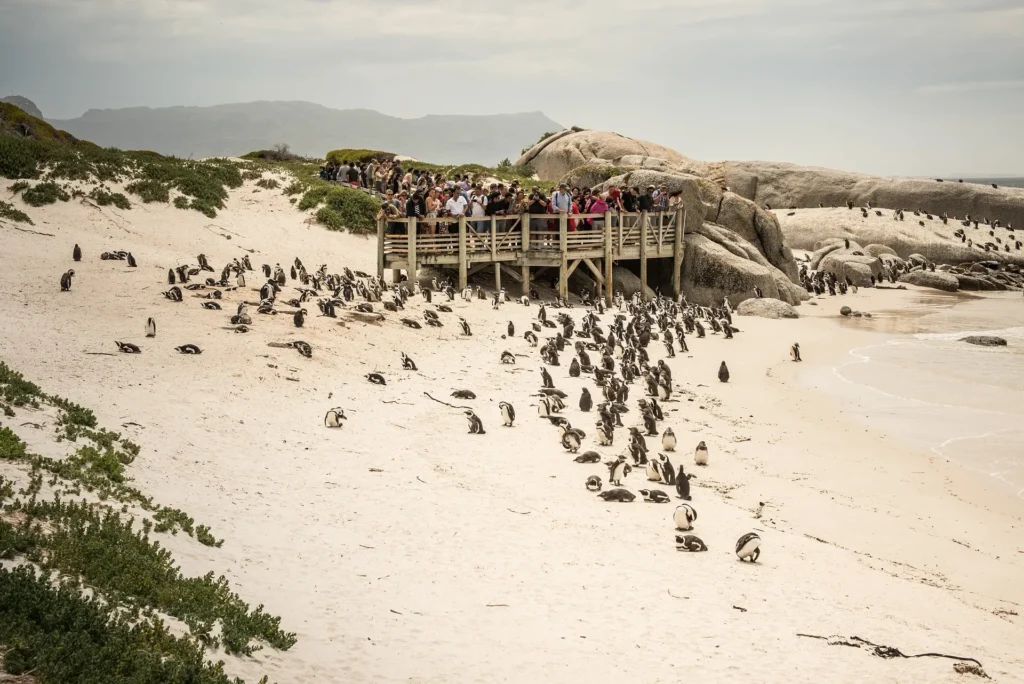
The peninsula ends at the Cape of Good Hope reserve, with cliffs and fynbos, the region’s unique vegetation. At Boulders Beach, in Simon’s Town, a colony of African penguins lives. Go early, because the route fills up.
Where to eat nearby: seafood in Simon’s Town and Hout Bay, with views of the bay.
Winelands: Stellenbosch, Franschhoek and Constantia
Less than an hour and a half from Cape Town are the valleys of Stellenbosch and Franschhoek, with vineyards of Chenin Blanc, Pinotage and high-level red wines. Do tastings at two or three estates a day, and no more, to enjoy them. Constantia, within the city, is the oldest wine region in the country.
Where to eat nearby: lunches at the vineyard, with pairing, and the cuisine of Franschhoek, considered one of the food capitals of the country.

Hermanus and the Garden Route
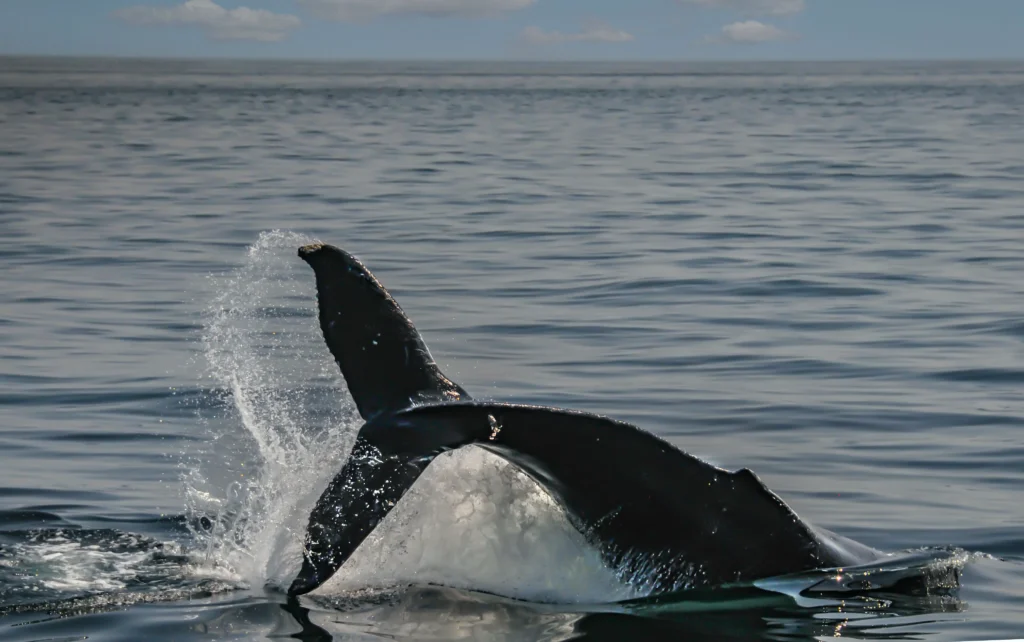
Hermanus, about two hours from Cape Town, is one of the best places in the world to watch whales from the shore, from June to November. Farther east, the Garden Route combines beaches, forests and lagoons between Knysna, Plettenberg Bay and Tsitsikamma, with trails and boat rides.
Where to eat nearby: Knysna oysters, grilled fish and wines of the region.
Safari in Kruger and Private Reserves
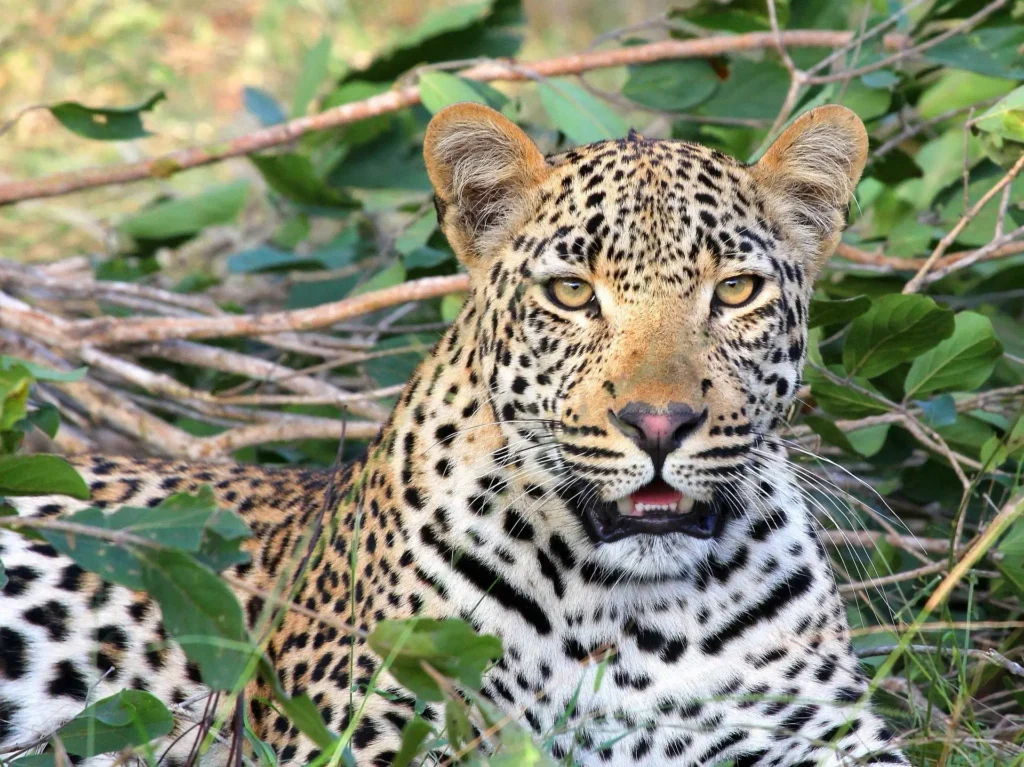
Kruger National Park is one of the largest parks in Africa and has the Big Five. The private reserves that border it, such as Sabi Sands, let you go off-road with trackers, see cats up close and do night safaris. Vehicles are open and groups are small.
Where to eat nearby: dinner in a boma, an outdoor enclosure with a fire, with braai (South African barbecue), boerewors and biltong, and a drink at sunset in the middle of the bush.
Malaria-Free Safari: Madikwe, Pilanesberg and Eastern Cape
Madikwe and Pilanesberg are a few hours from Johannesburg, and Addo, Shamwari and Amakhala, in the Eastern Cape, combine very well with the Garden Route. They are an excellent alternative if you travel as a family or prefer to avoid prophylaxis.
Panorama Route in Mpumalanga
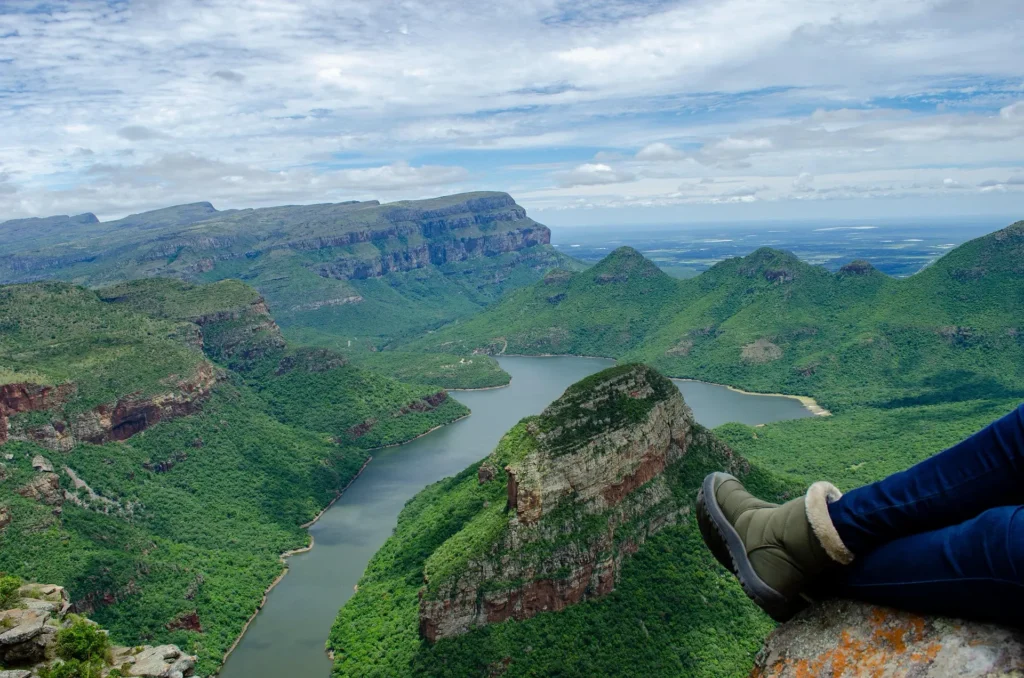
The Blyde River Canyon and its viewpoints, such as God’s Window, make up one of the most beautiful scenic routes in the country. It combines well with a stay in Kruger.
Johannesburg and Soweto: Living History
The Apartheid Museum in Johannesburg and a guided tour of Soweto, with Vilakazi Street, where Mandela and Desmond Tutu lived, help you understand the country. Do it with a local guide.
Where to eat nearby: South African cuisine in Soweto, with dishes such as pap (maize porridge) with stews.

KwaZulu-Natal: Drakensberg and the Zulu Coast
The Drakensberg mountains, with trails and rock art, and the iSimangaliso wetland park, with hippos and beaches, are a less-traveled alternative. In Durban, try bunny chow, bread filled with curry.

Stunning Restaurants in South Africa
South Africa has a first-rate food scene, and the most sought-after tables fill up weeks ahead. These are the ones that earned three stars at the Eat Out Woolworths 2026 awards, one of the best-known restaurant guides in the country. It is not the Michelin guide.
| Restaurant | City and area | What sets it apart | Reservation |
|---|---|---|---|
| Fyn | Cape Town, City Bowl | Restaurant of the Year 2026. It combines Japanese techniques with South African identity. | Several weeks ahead |
| La Colombe | Cape Town, Constantia | Three Eat Out stars 2026. | Several weeks ahead |
| La Petite Colombe | Franschhoek | Three Eat Out stars 2026. | Several weeks ahead |
| Mertia | Stellenbosch | Three Eat Out stars 2026. | Several weeks ahead |
| Pier | Cape Town, V&A Waterfront | Three Eat Out stars 2026. | Several weeks ahead |
| Salon | Cape Town, Woodstock | Three Eat Out stars 2026. | Several weeks ahead |
| Salsify at the Roundhouse | Cape Town, Camps Bay | Three Eat Out stars 2026. | Several weeks ahead |
| The LivingRoom at Summerhill | Pinetown, near Durban | Three Eat Out stars 2026. | Several weeks ahead |
My recommendation is not to fill the trip with fine-dining reservations. One or two memorable tables are enough, and between them a braai by a vineyard, a dinner in a boma after a safari or a lunch facing the sea in one of the bays of the Cape are worth more.
The most sought-after tables are part of the itinerary design from the start, because the travel dates depend on them.
Visa and Paperwork Before Your Trip to South Africa
U.S. citizens do not need a visa to enter South Africa as tourists, for stays of up to 90 days. There are still several requirements worth having clear before you travel, including the online traveler declaration introduced in July 2026.
| Procedure | What to know | When |
|---|---|---|
| Visa | No visa is needed for tourist stays of up to 90 days with a U.S. passport. The electronic travel authorization (ETA) that exists for some other nationalities does not apply to U.S. citizens. Confirm the current rule with the South African Department of Home Affairs before traveling. | Confirm when booking |
| Length of stay | Up to 90 days for tourism or short visits. It is not for working. | When planning the trip |
| Entry airports and ports | U.S. citizens arrive visa-free through the international airports, such as OR Tambo (Johannesburg), Cape Town and King Shaka (Durban). Other entry methods, such as by land or cruise, may have their own steps. | Confirm before buying the ticket |
| No need for an ETA | The electronic travel authorization (ETA) that applies to some other nationalities is not requested of U.S. citizens, so do not pay an intermediary for it. | Before starting |
| Passport | It should be valid for at least 30 days after your departure from South Africa and have at least 2 blank pages. My recommendation is that it have six months of validity. | Before buying the ticket |
| Onward ticket | Airlines and immigration may ask for a return or onward ticket within your authorized stay. | At boarding and on arrival |
| Traveler declaration | Fill it in online with SARS before traveling. It is best to do it the same day as your departure or the day before, and keep the confirmation. | Before the flight |
| Yellow fever | The international certificate is requested if you arrive from a risk country or make a long transit in one, for example Uganda or Kenya. If you combine South Africa with East Africa, carry it. | Get vaccinated at least 10 days before |
| Minors | Each child needs their own passport. South Africa has asked for extra documents for minors in the past, so it is wise to carry the birth certificate with the details of both parents. If traveling with only one parent, or with third parties, a notarized consent letter and a copy of the parents' identification are needed. | Before traveling |
| Travel insurance | Get one with international medical and evacuation coverage. | Before traveling |
How to Prepare Step by Step
- Confirm with your advisor the length of your stay and the current visa rule for U.S. citizens.
- Check that your passport has at least 2 blank pages and enough validity.
- Carry your onward ticket and your lodging details.
- Fill in the online SARS traveler declaration before the flight, and save the confirmation.
- Check the yellow fever rule if you combine countries.
- Get your travel insurance.
South Africa’s immigration rules changed several times between 2025 and 2026. That is why I prepare each procedure with my clients and review their status close to the travel date.
Beyond the Postcard: Reads That Reveal the Soul of South Africa
Before your feet touch its soil, let your mind travel. Here are my literary recommendations so you can soak up the essence of South Africa and experience every corner from another perspective.


Frequently asked questions about traveling to South Africa
Do I need a visa to travel to South Africa from the U.S.?
No. U.S. citizens can enter South Africa as tourists without a visa for up to 90 days. Your passport should be valid for at least 30 days after your departure and have at least 2 blank pages. Since July 1, 2026, you must also fill in the online traveler declaration with the customs authority. Confirm the current rule before traveling.
What is the best time for a safari in South Africa?
From May to September, the dry season. The vegetation is low, animals gather near water and the malaria risk is very low. October is also very good, and summer is better for the city, the vineyards and the beach than for safari.
How many days do I need for a trip to South Africa?
Between 10 and 14 days lets you combine Cape Town, the Winelands, the Garden Route or Hermanus, and a safari of three or four nights. With less time, the trip comes down to a single region.
Is it safe to travel to South Africa?
Yes, with precautions. Large cities have high crime rates, so it is wise to use private transfers or trusted apps, not walk at night in unfamiliar areas and visit townships with a guide. At lodges and on safari, the main care is following your guide’s instructions. Check the current U.S. State Department advisory.
Do you tip in South Africa?
Yes. At restaurants you leave between 10% and 15%, unless the bill already includes service. A car guard gets about 5 to 10 rand, and at a lodge you tip the guide and the tracker separately, plus a common box for the rest of the staff.
Is there malaria on safaris in South Africa?
It depends on the region. Cape Town, the Winelands and the Garden Route have no malaria. In Kruger and the northern reserves, the risk is higher from November to April and very low from May to September. Madikwe, Pilanesberg and the Eastern Cape reserves are malaria-free. Talk to your doctor about prophylaxis.
What can't I bring to South Africa?
You cannot bring drugs or narcotics, weapons, explosives, fireworks or counterfeits. Animal products, plants and some herbal products require authorization, and medications must be in their original packaging, with a prescription or doctor’s letter. You must also declare cash in large amounts.
Can I combine South Africa with other destinations in Africa?
Yes. South Africa combines very well with Victoria Falls in Zimbabwe or Zambia, the Okavango Delta in Botswana and the deserts of Namibia. If you pass through a yellow fever risk country, carry your vaccination certificate.
How much does a trip to South Africa cost?
It depends on the level and, above all, on the safari. As a reference, a 12 to 14 day trip with flights from the U.S. costs $6,200 to $8,600 per person at an essential level, $9,800 to $14,000 at an intermediate one and from $17,400 at a premium one, with trip design and management included. These are estimates from November 2026.
Let's Design Your Trip to South Africa Together
South Africa is enjoyed far more when the safari, the vineyards, the tables and the transfers are planned as a single trip. Tell me what you are looking for, whether wildlife, wine, history or the coast, and we will design it around you.
Combine South Africa With Other Destinations in Africa
- Botswana: the Okavango Delta and safaris in exclusive reserves.
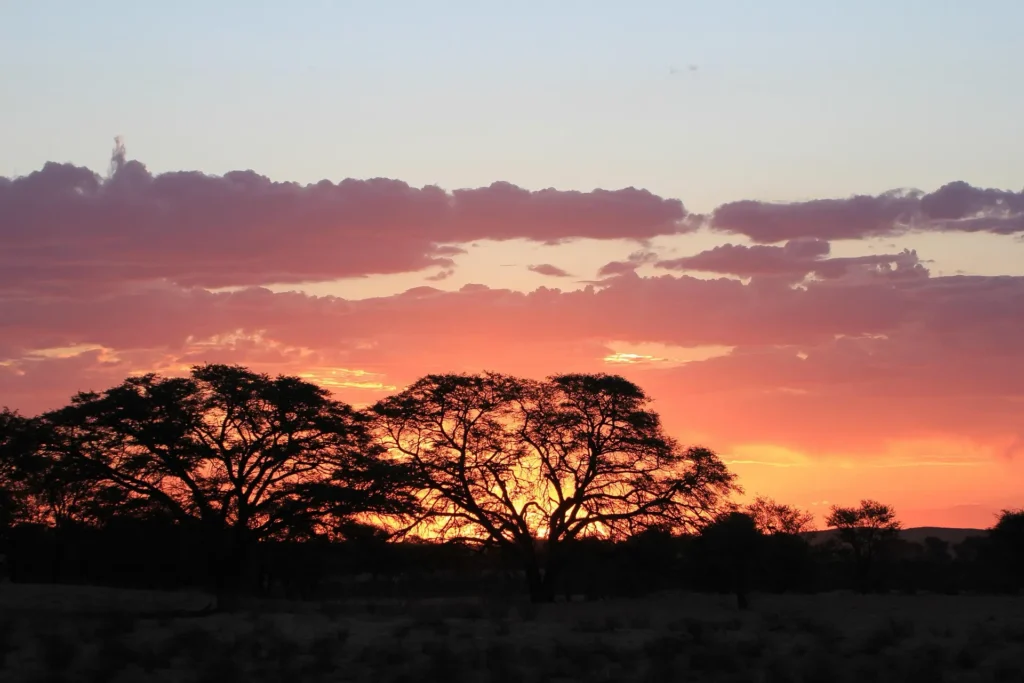
- Namibia: dunes, desert and starry skies.
- Zimbabwe: Victoria Falls and walking safaris.
- Mozambique: beaches and islands in the Indian Ocean.
- Kenya: the great migration and safaris in the Masai Mara.
- Tanzania: the Serengeti and Ngorongoro Crater.
If you travel with children, read my guide to family vacations in South Africa (in Spanish). If you are worried about safari, find out why a lion will not eat you on an African safari (in Spanish). To meet the women who protect wildlife, meet the Black Mambas, women anti-poaching rangers (in Spanish).
If you are traveling as a couple, discover my honeymoon trips. If you prefer to share the experience, explore the group trips.

Ari Garduno
Passionate traveler of the authentic, the unexpected and what leaves a mark.


Leave a comment